> ## Documentation Index
> Fetch the complete documentation index at: https://docs.mathfi.ai/llms.txt
> Use this file to discover all available pages before exploring further.
# MathFi.ai Documentation
> MathFi.ai docs: build production predictive AI models from CSV data in minutes on commodity CPUs. REST API, Python SDK, guides, and use cases.
Welcome to the MathFi.ai documentation, a platform to easily build predictive AI models from your CSV data and achieve outstanding prediction accuracy.
### Why MathFi.ai?
With MathFi.ai going from labelled data to accurate predictions is easier than ever:
* Create `datasets` from CSV files
* Get `models` trained in minutes
* Obtain high accuracy predictions using these `models` on unseen data
### What is MathFi.ai?
MathFi.ai is a production-ready predictive AI platform for tabular classification on imbalanced data. It uses Cellular Balanced Learning (CBL), a proprietary training approach built to solve the class imbalance problem that causes standard ML methods to underperform on fraud detection, anomaly detection, insurance claims, and rare-event prediction tasks.
Key differentiators:
* **No GPU required**: training runs entirely on commodity CPUs, cutting infrastructure costs compared to typical AutoML platforms
* **Fast training**: eight competing algorithmic pipelines converge to your target performance in minutes for most well-prepared datasets
* **Minimal configuration**: three hyperparameters control the entire training process (number of buckets, scaling factor, performance threshold)
* **API-first**: a predictive ML API that integrates into existing data pipelines or powers new prediction applications
* **Proven across industries**: financial services, insurance, healthcare, and any domain with imbalanced tabular datasets
Upload a labelled CSV, train a model, run inference. No infrastructure setup required.
### Who is MathFi.ai for?
MathFi.ai may be suitable for:
* In general, organisations looking to get insights on their existing data, getting started on their way to obtain meaningful predictions relevant to their business
* Data Science teams, to benchmark or complement their existing model development with a powerful platform to add to their existing toolchain
* Researchers and professionals looking to obtain reliable predictions on datasets they're collecting or building for a specific field (Healthcare, Fraud, ...)
To get started request early access via [Request access form](/get-access).
### How does it work?
As a quick glance, this is how MathFi.ai platform works:
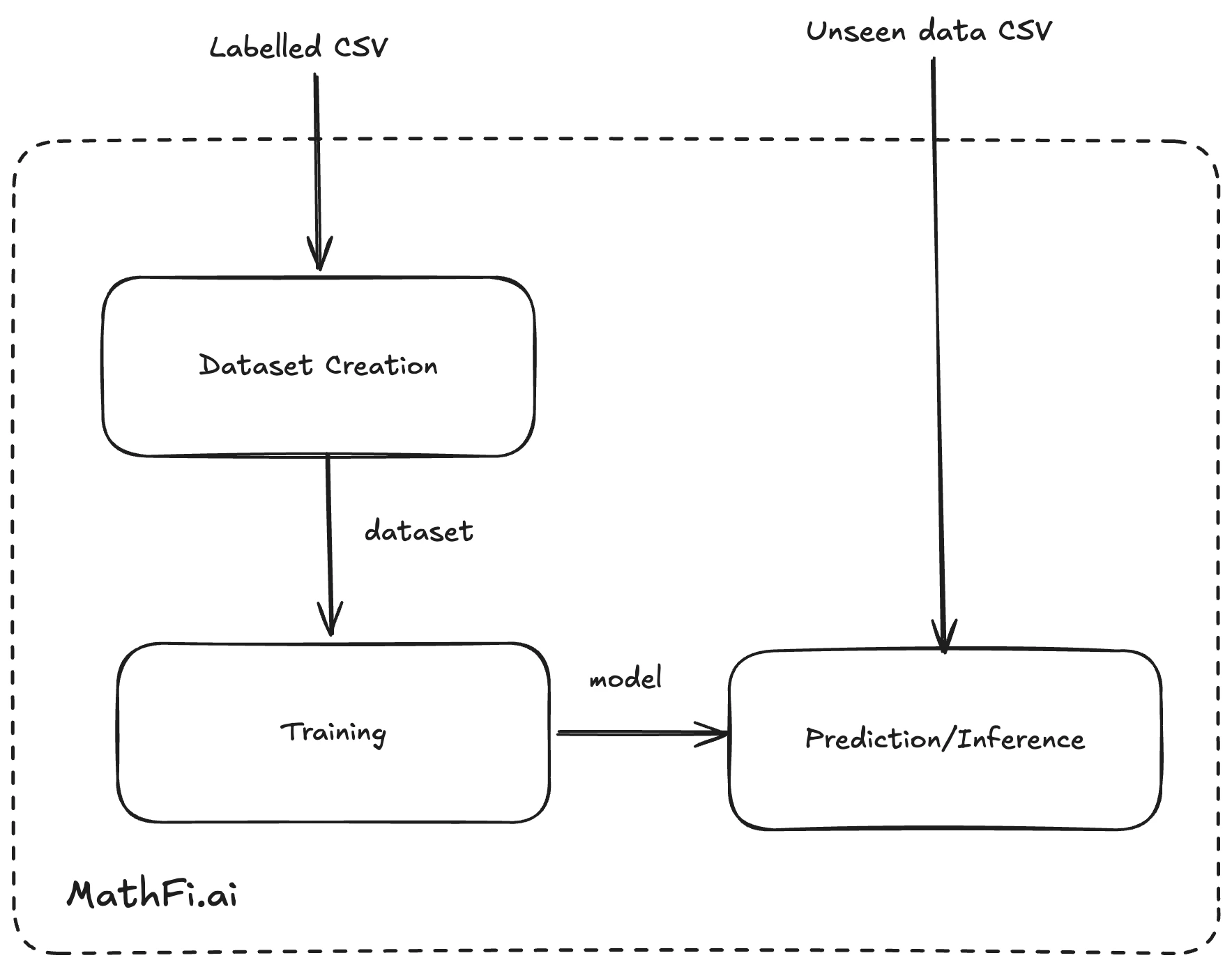 * Users prepare a tabular, `labelled data CSV` file with a set of features and an outcome ([guide](/guides/input-csv-creation))
* This input CSV is uploaded to the platform and a `Dataset` is created
* This `Dataset` is used to `Train` a `Model`
* The training process consists of a set of proprietary algorithms that compete with each other to achieve a given *target performance*. See [glossary](/glossary) for metrics used during training. A `Model` is created from the output of the winner algorithm
* 90% of labelled data is used for training, remaining 10% is stripped out of its labels and used for testing as part of the overall training process
* Training process runs *fast* (minutes or few hours) in most of the cases when the data is well prepared. MathFi.ai uses novel training algorithms that converge to the *target performance* or stall/stop way faster than other known classification methods
* If training stalls, times out or fails for any reason, the model won't be created
* Models won't be created if the newest *achieved performance* is not greater than existing for the given dataset
* Once there's an initial model created (*champion model*), predictions (inference) can be run by uploading an `unseen data CSV`. The trained `model` is used to accurately predict the unseen data and obtain a downloadable `prediction result CSV` output
### Use MathFi.ai
* Log into the platform and follow the [Quickstart](/quickstart) to test your access and start using the dashboard
* You can also directly start using your own data to get predictions:
* Format labelled and unseen CSV data for training and prediction following the [Input CSV Creation](/guides/input-csv-creation) guide
* Create datasets, train models and get initial predictions following the [Training guide](/guides/training-guide)
* Gradually improve the performance of your models following the [Hyperparameter tuning](/guides/hyperparameter-tuning) guide
* Eventually, integrate MathFi.ai within your existing workflows or create brand new apps using it as a base prediction engine
* Use the [REST API](/developers/api-overview), [API Recipes](/developers/api-recipes)
* After that, start using our initial version of the [Python SDK](/developers/python-sdk)
* Users prepare a tabular, `labelled data CSV` file with a set of features and an outcome ([guide](/guides/input-csv-creation))
* This input CSV is uploaded to the platform and a `Dataset` is created
* This `Dataset` is used to `Train` a `Model`
* The training process consists of a set of proprietary algorithms that compete with each other to achieve a given *target performance*. See [glossary](/glossary) for metrics used during training. A `Model` is created from the output of the winner algorithm
* 90% of labelled data is used for training, remaining 10% is stripped out of its labels and used for testing as part of the overall training process
* Training process runs *fast* (minutes or few hours) in most of the cases when the data is well prepared. MathFi.ai uses novel training algorithms that converge to the *target performance* or stall/stop way faster than other known classification methods
* If training stalls, times out or fails for any reason, the model won't be created
* Models won't be created if the newest *achieved performance* is not greater than existing for the given dataset
* Once there's an initial model created (*champion model*), predictions (inference) can be run by uploading an `unseen data CSV`. The trained `model` is used to accurately predict the unseen data and obtain a downloadable `prediction result CSV` output
### Use MathFi.ai
* Log into the platform and follow the [Quickstart](/quickstart) to test your access and start using the dashboard
* You can also directly start using your own data to get predictions:
* Format labelled and unseen CSV data for training and prediction following the [Input CSV Creation](/guides/input-csv-creation) guide
* Create datasets, train models and get initial predictions following the [Training guide](/guides/training-guide)
* Gradually improve the performance of your models following the [Hyperparameter tuning](/guides/hyperparameter-tuning) guide
* Eventually, integrate MathFi.ai within your existing workflows or create brand new apps using it as a base prediction engine
* Use the [REST API](/developers/api-overview), [API Recipes](/developers/api-recipes)
* After that, start using our initial version of the [Python SDK](/developers/python-sdk)
Follow the quickstart guide to make your first prediction
Integrate MathFi.ai into your existing workflows
In-depth guides for datasets, training and predictions
Real-world examples across industries